
- By Allfix star
- 07 Aug, 2025
- Interior Design
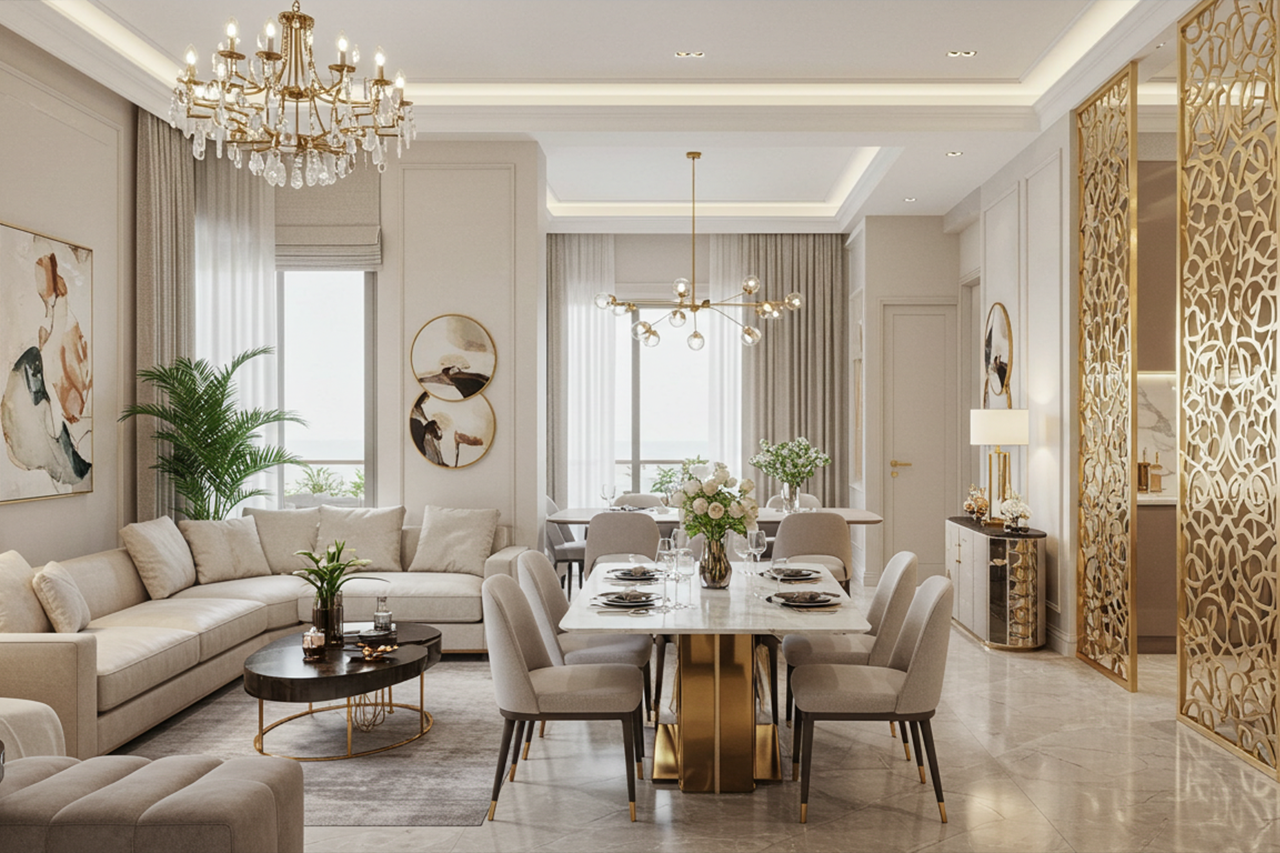
Explore 10 modern villa interior layout ideas that are redefining luxury living in Dubai for 2025. From open kitchen and living room flow to tranquil courtyards, smart utility zones, and split-level plans—these functional villa designs combine elegance with everyday comfort. Discover how Dubai’s latest home layouts are designed not just to impress, but to truly live in.
There’s a certain kind of home that doesn’t need to announce itself. It doesn’t rely on chandeliers or polished marble to make you feel something. It invites you in with quiet confidence. The kind of home where space moves with you, where the light doesn’t glare but glows, and where you never need to question why things are where they are.
That feeling, the one where you breathe a little easier, is rooted in one thing: the layout.
In Dubai, villas often come with grandeur by default. But in 2025, the most desirable homes are not the biggest or the flashiest. They are the ones that feel natural to live in. Where nothing is wasted and nothing is in the way.
Design today is leaning less toward trend and more toward texture, rhythm, and everyday grace. The layout is no longer a background detail. It’s the first step toward comfort. Here are ten design layouts that are quietly reshaping how Dubai’s villas feel and function.
Each one is rooted in how people actually live, not just how they want their homes to look.

1. A Kitchen That Feels Like Part of the Living
The days of the closed-off kitchen are over. In a modern Dubai villa, the kitchen is where life happens. Not just cooking, but talking, working, and simply being present.
● Place the kitchen where it shares space with the lounge, allowing for interaction without interruption.
● Install a central island that serves as a prep area, casual dining spot, and social anchor.
● Use open shelving sparingly to make the space feel light, but keep the clutter hidden below.
● Let the same flooring run through both kitchen and living areas to remove visual barriers.
● Make sure natural light flows through shared windows, so the kitchen isn’t left in shadow.
This kind of layout makes the kitchen feel like an extension of everything else. You stay connected, whether you're making tea or setting out snacks. The space supports multitasking without chaos. It becomes not just a kitchen, but part of the household’s rhythm.
2. Split-Level Zones That Guide Without Walls
Villas with wide open spaces can sometimes feel formless. Everything merges into everything else. Split levels offer subtle ways to organize space without resorting to walls.
● Introduce a shallow step up or down to divide social and private spaces.
● Shift ceiling heights slightly to define the atmosphere of each area.
● Use floor textures, stone below, wood above, to signal a mood change.
● Arrange furniture to follow the level changes and reinforce their purpose.
● Add built-in ledges or low dividers that double as storage or display.
This kind of spatial layering brings a natural hierarchy to the home. You can host guests in one zone while keeping another relaxed and quiet. Movement becomes intuitive. Each level whispers what it's meant for, without needing labels.
3. Bedroom Placement That Respects Stillness
It’s not enough for a bedroom to be quiet. It needs to feel tucked away. The best bedroom layouts create physical and emotional space between rest and the rest of the house.
● Place the primary bedroom far from active areas like the kitchen and lounge.
● Design a transitional space, such as a hallway or sitting nook, before you enter.
● Group secondary bedrooms near each other for efficiency but not congestion.
● Use staggered walls, deep doorways, and acoustic insulation to mute sound.
● Orient the room away from street-facing windows when possible.
A bedroom should never feel like it’s borrowed space. It should feel owned. When the layout grants that kind of separation, rest becomes deeper and mornings start without resistance.
4. Courtyards That Quiet the Interior
Not every villa needs a sprawling garden. But every villa benefits from a moment of stillness. A courtyard or light well can serve as the emotional center of the home.
● Place a courtyard in the middle of the villa so surrounding rooms pull in light from it.
● Add a tree or vertical plant wall to soften the light and introduce life.
● Use stone or gravel flooring that cools the space and quiets foot traffic.
● Make the courtyard accessible, not just visible, with a simple path or step-in area.
● Allow partial shade so that it's usable year-round, not just something to look at.
This central space doesn’t need to be large. Its job is to make the air feel fresh and to create a pause. Light moves differently when it filters through something living. Rooms around the courtyard become calmer without needing to compete for attention.
5. Guest Rooms That Flex With Daily Life
A room that only comes alive when guests arrive is a wasted opportunity. The smartest guest room layouts serve multiple roles with minimal compromise.
● Use a foldaway bed or daybed that blends with lounge or office furniture.
● Incorporate a workspace with a desk that doesn’t dominate the room.
● Use sliding doors or curtains that can open fully when privacy isn’t needed.
● Include lighting that dims or shifts from work to relaxation.
● Choose a neutral palette that feels welcoming but not impersonal.
This is how you create a space that adapts with you. Monday it’s an office. Thursday it’s a reading room. Saturday it’s a place for a visiting friend. The layout allows identity to shift without confusion.
6. Dining Areas That Invite Rather Than Intimidate
In many villas, the dining room ends up as a passageway or a showroom. It looks right but feels wrong. A good dining area draws people in without trying too hard.
● Keep the table close to the kitchen but not in its shadow.
● Choose natural light during the day and a low-hanging pendant for evening.
● Mix seating styles, benches, chairs, even a built-in corner seat, to remove formality.
● Let one wall act as soft storage or display, not a blank surface.
● Use the room daily so it doesn’t feel frozen in place.
Dining becomes an experience, not a performance. You stay longer at the table. Conversations stretch. There’s no stage, just presence.

7. A Mudroom That Saves the Rest of the House
The entrance sets the tone. If it’s chaotic, everything after feels rushed. A mudroom brings calm before you even step inside.
● Design it near the main door, ideally between garage and kitchen.
● Include closed cabinets for shoes, bags, and seasonal clutter.
● Add open hooks and shelves for quick access items.
● Provide a bench to sit or drop things during busy moments.
● Use tile or stone flooring that’s durable and easy to clean.
This isn’t about tidiness for its own sake. It’s about giving the mess somewhere to land so the rest of the house doesn’t suffer. The benefit becomes visible within a week of using it.
8. Shared Bathrooms That Don’t Feel Like Compromise
When done wrong, a shared bathroom is a bottleneck. When done right, it feels balanced and intuitive.
● Position it between two rooms with private doors from each.
● Create separate zones for shower, toilet, and sink to allow parallel use.
● Use mirrored cabinets and dual vanities to reduce collision.
● Keep lighting soft but layered for different needs.
● Design storage for individual users to avoid confusion.
It’s not just about saving space. It’s about creating a neutral ground that feels like it belongs to everyone using it.
9. Outdoor Areas That Extend Daily Living
Too many outdoor spaces are treated like extra credit. The layout treats them as afterthoughts. But in Dubai, with its cooler months and starry nights, these spaces deserve better.
● Position the outdoor area as a continuation of your living room.
● Use matching or complementary flooring to blur the boundary.
● Add shade through pergolas or retractable covers.
● Include lighting and fans that make the space usable at different times.
● Build seating into the design rather than relying only on furniture.
This kind of outdoor room doesn’t need events. It becomes the place for everyday pauses. Morning coffee. Evening air. Quiet reading. That’s enough.
10. A Utility Core That Disappears Until Needed
A well-functioning villa often comes down to one thing, how cleanly the services are integrated. Plumbing, HVAC, electrical, all need structure.
● Run all major services through a central wall or shaft.
● Stack wet areas like kitchens, bathrooms, and laundries for easier maintenance.
● Keep access points discreet but reachable.
● Use doors, not panels, to conceal major service zones.
● Place utility space away from bedrooms and social zones to minimize sound.
When systems work quietly, you can forget them. Until you need to fix something. And then, because of layout, it doesn’t become a crisis.
Frequently Asked Questions
Why
is layout more important than finishes or styling?
Because layout affects how you move, rest, and connect
in a home. A perfect tile or fabric means nothing if you trip over your own
furniture daily. Layout is function before form.
How
do I add privacy without building new walls?
You can use bookshelves, screens, level changes, and
furniture placement. Soft separation often works better than fixed barriers in
villas with large open plans.
Should
bedrooms always face sunlight?
Not necessarily. You can reserve the brighter
orientations for living areas. Bedrooms do well with soft light or shaded
exposure, especially for mid-day rest or early sleep.
Is
it practical to include courtyards in smaller villas?
Yes. Even a two-meter square light well with a tree or
garden wall can improve airflow and bring natural light into central rooms.
Can
dining areas double as workspaces?
They can if they are not over-styled or underused. A
layout that allows movement and easy access to storage makes this practical.
Are
mudrooms essential in Dubai villas?
Absolutely. Sand, shoes, shopping, and deliveries all
come through the door. A mudroom helps contain them.
Is
it possible to make outdoor space usable year-round?
With shading, fans, misting, and well-placed plant
cover, yes. You just need to design for seasonality, not assume outdoor equals
open.
How
do I get airflow without over-relying on AC?
Create cross-ventilation by aligning windows, using
courtyards, and leaving interior doorways open where possible.
What
should be avoided when planning a utility core?
Scattering services across multiple walls, placing
noisy systems near bedrooms, and making plumbing lines too long or complicated.
What’s
the most important thing to remember about layout?
It should follow how you actually live, not how you
think a home should look. Good layout feels quiet, even invisible, because it
simply works.
Final Word
A layout is not just an architectural plan. It’s a set of possibilities. It’s where your day begins and ends. The best villas in Dubai aren’t defined by flash. They’re defined by spaces that hold you gently, that guide without pushing, that disappear into the background while quietly making everything feel easier.
That’s good design. And it always starts with layout.